
The work behind the work - paintings; process, and the life around it.
~~~~~~
The work behind the work - paintings; process, and the life around it. ~~~~~~
The finished painting isn’t the whole story. This is where I work through where the work comes from, how it takes shape, and what it asks—both in the making of it and in the living with it.
Series & Projects:
(The stories behind the themes)
Studio Life:
(The storys that led me here)
For Collectors:
(Taking charge of your relationship with art)
Sereis & Projects
---
Sereis & Projects ---
The Cafe Series
(or, The Barista at the End of the World)
Here’s the short version: the café paintings are about how something completely ordinary became briefly, absurdly precious.
They started in early 2020, back when sitting in a crowded café felt so normal it barely registered as an experience. Coffee, noise, slightly overbaked muffins—the usual. I made a quick sketch and thought nothing of it.
Then the world closed.
Suddenly that sketch looked less like a note and more like evidence. Proof that people once sat close together without negotiating airflow strategies. So I painted it. Not out of nostalgia exactly—more out of disbelief that something so routine could vanish that quickly.
When cafés reopened, they came back… altered. Plexiglass everywhere. Floor arrows. Outdoor tents that suggested optimism but delivered wind. You could still get coffee, but now it felt like a carefully managed event.
That’s when the series found its footing.
One moment in particular: a barista behind a plastic barrier, mid-shift, visibly done with everything. Not dramatic—just a quiet, professional level of exhaustion. It had the strange compositional gravity of A Bar at the Folies-Bergère, if Manet had access to sanitizer and public health signage.
That became Café Lockdown.
From there, the series grew into a study of small human adjustments: how people kept showing up, kept ordering coffee, kept trying to feel normal in spaces that clearly weren’t. It’s less about the pandemic itself and more about the awkward resilience around it—the way we adapt, slightly badly, and carry on anyway.
At its core, the Café Series is about this:
places we take for granted, right up until they disappear—or get very, very strange.

Series & Projects
---
Series & Projects ---
There’s More Than Just Running Here.
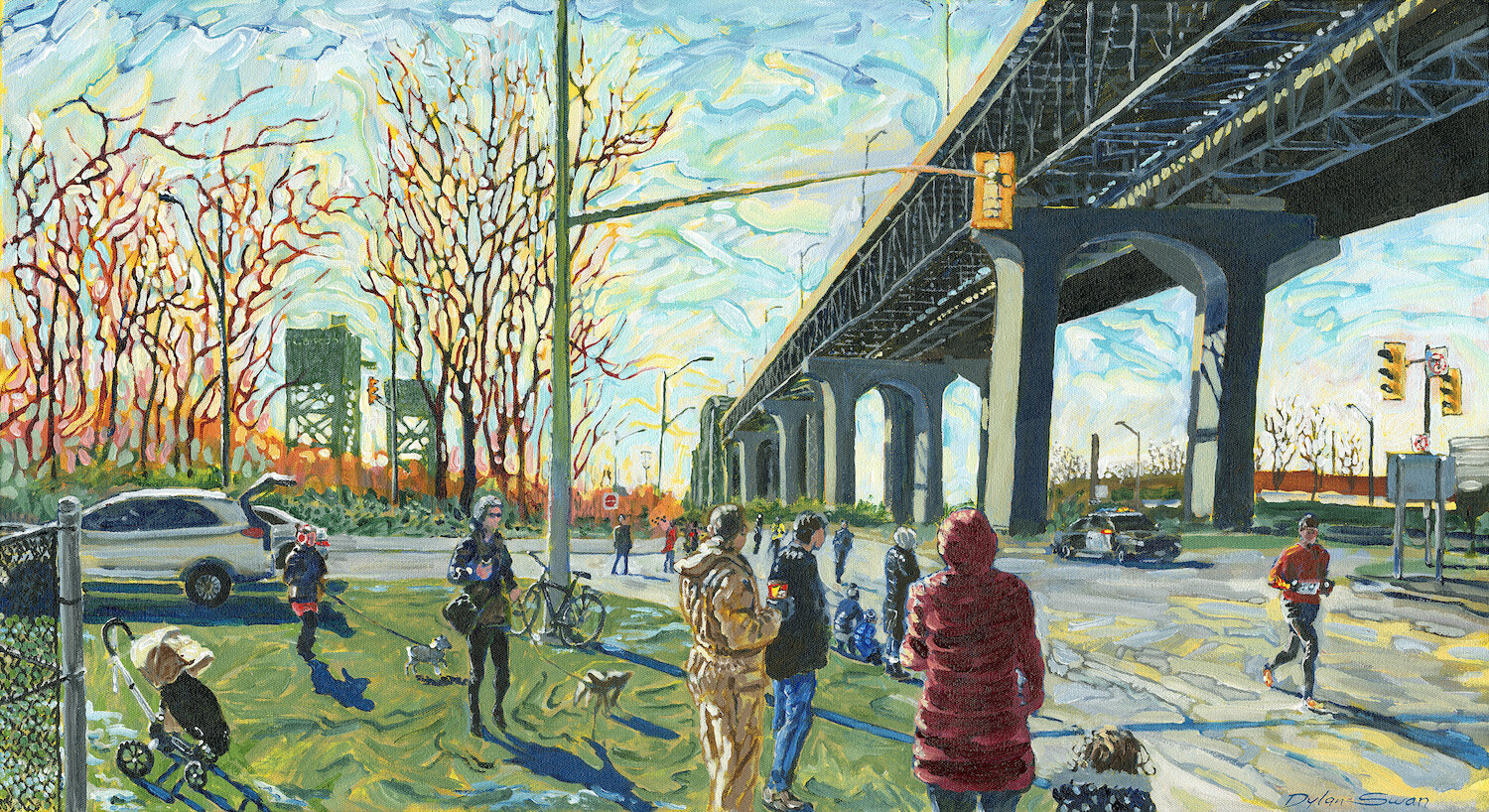
Here’s the blunt truth: the story isn’t about running. Running is just the decoy. The real subject is what happens on the sidelines.
I tried running. Briefly. It turns out willingly jogging long distances in Canadian weather requires a level of optimism I don’t possess. I did manage to complete the Around the Bay 30k in Hamilton—the oldest road race in North America—which sounds noble until you realize your lungs are staging a protest and no one is handing out medals for poor decision-making.
But something useful happened out there.
Not on the course—around it.
Crowds line the route for hours ringing cowbells, holding signs, and confidently lying to strangers about how close the finish line is. And it works. Runners believe them. Or at least choose to. There’s an unspoken agreement: you keep moving, we’ll keep pretending this is almost over.
That exchange is the work.
The paintings focus less on competition and more on encouragement—the odd, generous instinct people have to lift up someone they’ll never meet again. The leaders get cheers, of course. But so does the last runner, long after the finish line has packed up and gone home. Sometimes louder.
That’s the part worth paying attention to.
The Around the Bay series follows the race one kilometre at a time—thirty-one paintings built from fragments of observation, memory, and selective honesty. It took years to complete, which is fitting for a project about endurance that required none of the physical kind.
The newer Boston series expands on the same idea. Bigger race, bigger crowds, same quiet phenomenon: effort on one side of the street, encouragement on the other, and something human passing between them.
No one is keeping score there. No one needs to win for it to matter.
Which makes it a surprisingly rare subject.
Studio Life
---
Studio Life ---

About The Artist
Dylan Swan paints real places—mostly the kind you’d walk past without noticing, until something in the light or the stillness catches you.
Cafés. Street corners. Rows of houses in a certain kind of weather. His work leans slightly impressionistic, but it’s grounded in observation and a quiet attachment to the ordinary. Less about spectacle, more about presence—being somewhere long enough for it to matter.
Born in Ontario and now based in Nova Scotia, Dylan divides his time between painting and massage therapy. One is practical, the other is harder to explain, but both rely on attention, intuition, and a willingness to stay with something until it makes sense.
He’s currently building a home with his wife in the countryside—part studio, part experiment in doing things the hard way on purpose. Most days involve some combination of painting, problem-solving, and trying to remember where the tools were set down last.
The work shown here moves between finished pieces and the stories behind them—how they came together, where they came from, and sometimes why they were worth sticking with.

Studio Life
---
Studio Life ---
The Giant
I was the quiet kid in the back row—half-listening, mostly drawing. Homework didn’t stand a chance against whatever was taking over the margins of my notebook.
One day the teacher was gone. In walked the principal. Big guy. Beard. Looked like he could bench press the classroom.
No sudden movements. Just survive the day.
Then—thud.
His finger landed on my doodle.
This is it, I thought. I’m done.
But instead, in an unexpectedly gentle voice:
“That’s beautiful.”
Wait… what?
I glanced up. The giant had softened. Not angry. Not annoyed.
Something else.
“But you need to do the math, son,” he added with a sly grin.
Fair enough.
That moment cracked something open.
Maybe I wasn’t just the awkward kid not doing his work.
Maybe I had something worth paying attention to.
It didn’t change everything overnight. I was still a daydreamer.
But drawing wasn’t just an escape anymore.
There was light there now.
And I could finally see it.
Studio Life
---
Studio Life ---
The Mirror
Art became my thing. The one place where things made sense. So art school felt like the obvious next step.
But somewhere along the way, it got… weird.
The message was: art is everything.
Which sounds inspiring—until everything starts to feel like nothing.
I felt stuck inside my own head. Like I was just making more… me. Over and over again. A hall of mirrors.
I needed out.
Around that time, life shifted. My mom passed away. I started studying anatomy—originally just to get better at drawing the human figure.
But something clicked.
The body wasn’t just something to observe—it was something to understand. To help. The student clinic became more than practice. It felt… useful. Grounded. Real.
So I followed that.
I built a life. A career. Something that actually mattered to people standing right in front of me.
And for a while, art just… faded out.
Until it didn’t.
Years later, it came back—but different. No pressure. No identity crisis. No mirror.
Just an old friend, showing up again.
Now it sits quietly in the corner of my life.
Not demanding anything.
Just waiting—like it always has—for the next story
For Collectors
---
For Collectors ---
The Ugly Ducklings of Your Art Journey.
Bad paintings are not an unfortunate side effect of making art. They are the process.
Most people try once, don’t like what they see, and quietly conclude they lack talent. This is a very efficient way to avoid becoming an artist.
The reality is less dramatic and more inconvenient: you have to make a lot of bad work. Not one or two. A sustained, almost impressive volume of it. Think less “mistake” and more “inventory.”
Early on, everything feels slightly off—like you aimed for something specific and produced a distant relative of it instead. That gap is the work. You close it by showing up again, not by waiting for inspiration to apologize.
People like to talk about talent as if it’s the deciding factor. It isn’t. Talent might make the first few attempts less alarming, but it doesn’t carry much weight over time. Persistence does. The willingness to keep producing things that aren’t quite right yet.
Every finished piece sits on top of a quiet pile of failed ones. That pile isn’t embarrassing—it’s structural.
So if the work in front of you looks wrong, that’s not a sign to stop.
It’s a sign you’re doing it properly.
For Collectors
~~~~~~
For Collectors ~~~~~~
You Seem Like Someone Who
Might Accidentally Start an Art Collection.
(Warning: This Blog Post May Contain Trace Amounts of Sales Pitch)
The art you collect says as much about you as it does about the artists behind it. In fact, your collection—whether it lives on your walls, your bookshelf, or your bathroom door (no judgment)—is basically your inner world made visible. It’s like interior decorating… with a soul.
Now, let’s address the obvious: not everyone has the budget to buy original art. Most artists understand this. In fact, many of us are painfully aware of the tragic twist that we ourselves often can’t afford our own work. It’s the ultimate plot hole in the “successful artist” narrative.
That’s why a lot of artists (myself included) offer work at a variety of price points. There are canvas prints, fine art giclées, open and limited edition runs. Some pieces come as postcards, mugs, or pillows—because nothing says “I support the arts” like resting your head on someone’s weird little bird painting.
And here’s the thing: a good art collection doesn’t need to be made entirely of originals or curated by a moody man in round glasses. You don’t need a gallery budget or a degree in art history. All you need is curiosity, a bit of wall space, and a willingness to live with images that speak to you (or at least raise a charming eyebrow at you while you eat breakfast).
When you start small—maybe with a print or a piece that makes you inexplicably happy—you begin to notice what you like living with. You get to know your own taste. You start to understand why you’re drawn to certain colours, moods, or subjects. And when the time comes to invest in something bigger, you’ll do it with confidence. You’ll know that piece belongs with you, and why.
And hey—if one of those pieces ends up being mine? That’s wonderful. Truly. I promise not to get emotional. (Or at least not until I’m alone with a cup of tea and a spreadsheet.)
For Collectors
~~~~
For Collectors ~~~~
Lets Make A Deal.
Every now and then someone tells me they’d rather buy directly from the artist—cut out the middleman, save a bit of money, maybe help the artist more. They usually say this right after expressing mild outrage that galleries take around 50%.
I get it. On the surface, it sounds like a raw deal.
But here’s the part most people miss.
If you’re buying from a hobbyist or someone dabbling, sure—pay what feels fair and carry on. No harm there. But if you’re buying from an artist who is actually trying to build a career—someone in it for the long haul—the gallery isn’t a parasite. It’s a partner.
An artist’s livelihood doesn’t hinge on a couple of one-off sales. It depends on sustained exposure, credibility, and—most importantly—a solid relationship with the gallery representing them.
Now imagine this: the artist sells you a piece for less than the gallery would charge. That undercuts the gallery directly. You’re not sticking it to “the system”—you’re quietly sawing off the branch the artist is sitting on. Galleries don’t love that. In fact, they tend to respond by dropping the artist altogether. Fair enough.
Okay, so what if you pay the full gallery price, but buy directly so the artist keeps the extra? Sounds better, right?
Short term, maybe. Long term, not really.
When a gallery sees work selling through them, they pay attention. They promote that artist more. They give them better placement, more shows, more visibility. That’s how careers grow. When sales happen off the books, that momentum disappears. The artist might win a little today and lose a lot tomorrow.
As for that 50% cut—yes, it’s significant. It should be. Good galleries earn it. They don’t just hang work on a wall and hope for the best. They build relationships, market the artists, talk to collectors, and create the kind of environment where the work actually gets seen—and sold.
So when you find a piece that speaks to you, and there’s a gallery behind it, remember: you’re not dealing with a middleman.
You’re looking at a team.
And if you want to support the artist properly, support the team that’s helping them build something that lasts.